
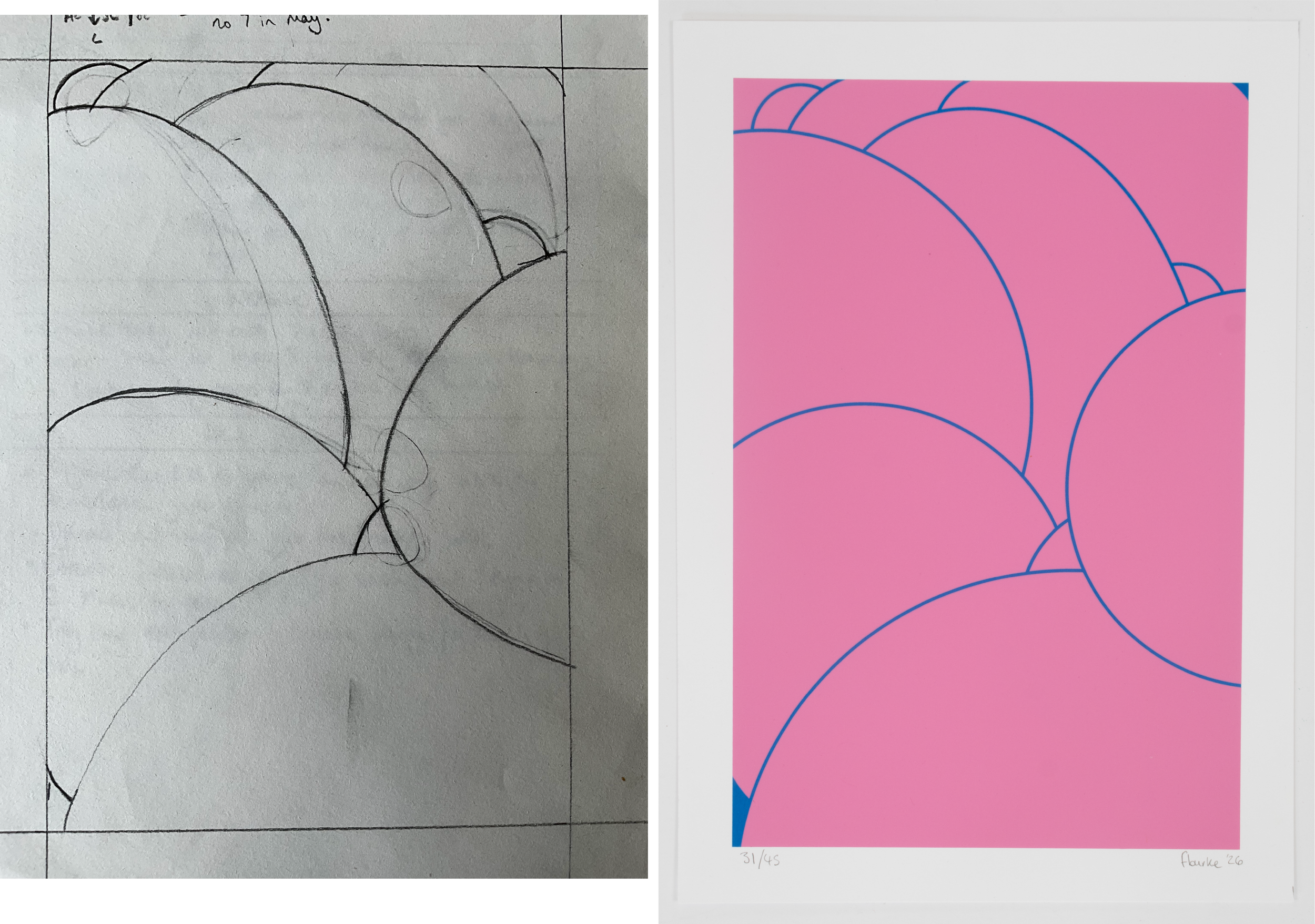
Original sketch and end result for one of my favorite prints - Bloom (merg) 2026
Tape 04 -- Sketch 25.07.26 --
Tracks -- Aphex Twin, Xtal. Waylon Jennings, Are You Sure Hank Done It This Way?. Germs, Lexicon Devil --
All of my prints start with a pencil sketch. Sometimes these sketches come about when I need them. Sometimes I can sit down with the full intention to draw something and come up with nothing, sometimes I’ll absentmindedly doodle something on the back of an envelope while on hold and that will become eventually become one of the prints that I’m most proud of. Even before I tried my hand at screen printing this was the process - - roughly outlining a design or illustration by hand, digitising them, then editing the results. For a while, and before I discovered screen printing, I was happy with this process. However I couldn’t help but feel as though there was something missing from the process, as if I was missing the final step. I was proud enough of the end results but a small part of me couldn’t help but wonder if there was a medium that was better suited to my work.
One of the earlier design clients that I had was an independent upholsterer who needed some printed material - - pamphlets, display material etc - - put together for an industry show. Up until that point all of my work had been digital only so I was more than happy to try my hand at something new. To my surprise picking up the proofs from the commercial printers we were using sparked an idea that I hadn’t anticipated. There was something about actually producing something tangible, an object that can be held and observed, that appealed to me. Having an actual print in my hand also changed the way I felt about the work itself. That flatness, or the missing final step of the process, that I had perceived in what I was producing wasn’t present when it was printed. I would do a few more printed projects like this, and each time I would see how much more alive the work was when printed, how the colours I used would interact with paper much more vividly than they would on screen. Discovering screen printing felt like the logical next step in that process. I realise that I felt like a designer in search of a medium. Someone who was looking for the best method to produce the work that I wanted to, and screen printing provided the perfect methodology to do that.
Tape 03 -- Heatwave 28.05.26 --
Tracks -- The Specials, Too Hot. Goldie, Dragonfly. Thelonious Monk & Sonny Rollins, I Want To Be Happy --
After struggling through a heatwave for the last few days temperatures are now (finally!) starting to drop again. This kind of heat pretty much rules out screen printing, for me at least. You’re already in a race against time when you’re printing at the best of times, let alone during a heat wave. The ink that we use to screen print (which despite the name is actually closer in consistency to acrylic paint) won’t dry immediately on its own, but when we prime/flood the screen we push a thin layer into the mesh, which can dry out pretty quickly. Combining this with an unusually hot ambient temperature can speed this process up even more, adding to an already stressful process. There are ways around this of course: additives you can add to the ink to slow the drying process or thin the ink, you could always add water to it while its on the screen.
But these come with their own downsides. Adding too much additive can mean the ink will actually take too long to dry or effect the colour/quality of the ink, adding water will effectively make the next few pulls of the screen useless so you’ll have to print onto newsprint several times before you can start the printing process again. Heat also isn’t the only thing that can have an impact on the printing process. Too much moisture in the air (e.g on a rainy day or, even, if the door to the washout room is left open while the power washer is running) can add to the drying time, leaving prints in the racks in an improperly ventilated space can cause the exposed paper to start to yellow. Store ink in a space that gets too cold and it can start to effect the consistency, becoming overly thick and hard to work with.
These are the kind of considerations that are obvious to me now but took a lot of getting used to. The second course I did took place on a hot day mid august, I was taking too long to register my second layer so my ink was starting to dry out resulting in the characteristic blotchy appearance of when that happens (almost like a vintage/distressed filter or texture you might use in photoshop). Luckily the course was being led by an experienced printmaker who taught me how to deal with that when it happens - mist the screen with water, quickly flood + pull + flood + pull onto sheets of newsprint until the ink comes through correctly again - How the conditions of where you print can impact the quality of what you produce is something you learn as you go along. Learning to screen print can feel as much a case of learning how to respond to conditions on the day as anything else.
Tape 02 -- Repeater 27.04.26 --
Tracks -- Hüsker Dü, Something I Learned Today. Erykah Badu, Didn’t Cha Know. Tim Maia, Nobody Can Live Forever --
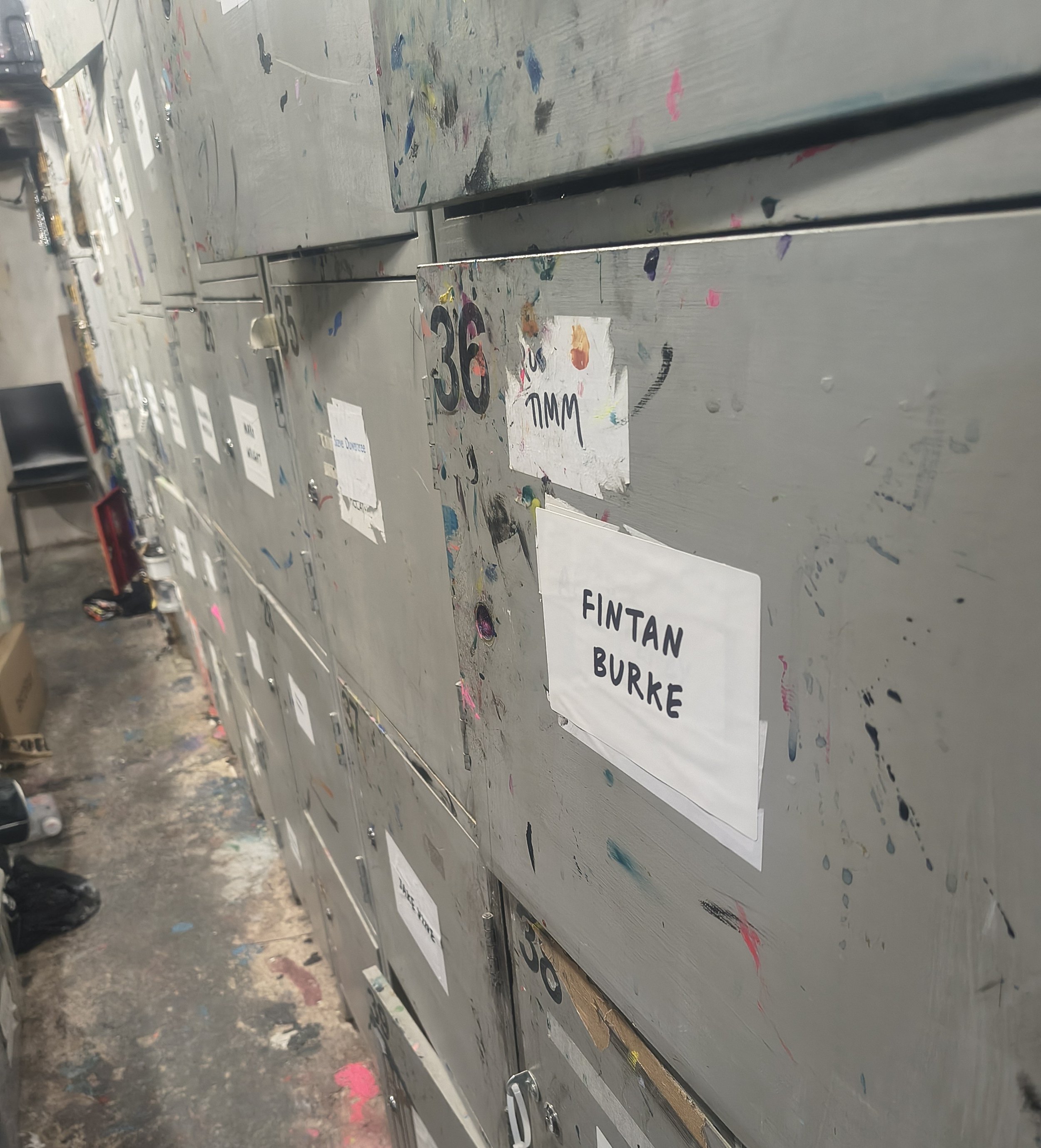
This month I started at a new studio. Although now that I think about it ‘new’ may not be the most accurate word to use, as I do have previous experience with Print Club London. It was here, after all, that I tried screen printing for the first time, on a sweltering august day several years ago. Even if the space is not entirely new to me starting a full time membership at a mainly unfamiliar studio does bring back some familiar nervousness. Everyone at the studio has been very welcoming, and the fact that it has such a laid back, friendly atmosphere was one of the main reasons I wanted to become a member here.
But its still a new(ish) studio, with its own way of doing things and it can feel like I’m back to being a beginner again. Thankfully, this feeling hasn’t lasted for long and I’m already starting to settle into a rhythm, figuring things out as I go along. I’ve been lucky enough to work at a few studios, in a few different cities, and increasingly I’ve started to notice the benefit in doing so. As I’ve come to learn every studio has a different way of doing things, each piece of equipment has its own quirks (and believe me when I tell you when that there are a lot of ways in which different tables, exposure units, and washout spaces can be wildly different!), and having enough experience with adapting to different studios has made the process a lot easier.
Besides, I do believe that there’s something about the screen printing process that does sort of lend itself to getting you used to a new space quickly. Its a process that’s built about repetition, and once you’re in the swing of things the movements are familiar enough that it helps you get used to being a new space, using unfamiliar equipment. Paper, register, screen down, flood, pull, screen up, rack, repeat. Each and every print I make has my full attention, but theres enough of a mechanical element to the movement that it becomes familiar wherever you do it.
Tape 1 -- Sooner or later 17.03.26 --
Tracks -- Minutemen, History Lesson Pt 2. Ratboys, It’s Alive!. Jack Adkins, American Sunset --
When I first sat down to start this blog I couldn’t figure out the best name for it. For anyone familiar with screen printing it might seem odd that I eventually chose to call it ‘tape’ rather than something more obvious like ‘squeegee’ or ‘ink’ (or something even more niche ‘exposure unit’). Tape, of various types, plays an important role when come to a typical screen printing set up, but its not really the first thing that comes to mind when you think about the process. I called it ‘tape’ because out of all the (many) steps you have to go through in order to screen print remembering to tape my screen before I clamped it on to the screen printing table was the stage that I struggled with the most.
For those not in the know- to be able to screen print you first need to apply the thin layer of photosensitive emulsion to a screen in order to create a stencil to push the ink through onto your paper. To do you this you use a wide metal applicator called a ‘trough’ (another potential name!) to coat the screen. This trough usually leaves a thin margin of screen uncoated around the edges, which you then have to cover with brown packaging tape to prevent ink being pushed through onto the printing table outside of your paper.For some reason, when I was first starting out I almost always forgot to do this step before I started to print, instead I would find myself trying to skip ahead, rushing to get the screen into the frame of the table. Thankfully there usually someone there to, gently, remind me to tape my screen before I got started, meaning I never actually managed to get ink on the table. That isn’t to say that I was completely confident in the other stages of the process either. I’d use the wrong size squeegee, or leave a pallet knife on the wrong part of the table so that the frame couldn’t lower properly, or forget to put the small length of hose on the edge of my screen necessary to create a proper vacuum when using the exposure unit, plus a whole litany of other odd missteps in the process. I would start to feel confident that I was getting comfortable with printing only to encounter some weird new problem that I’d never come across before (screen printing ultimately being a process that actually seems to enjoy wrong footing you when you think you’ve got it figured out). Once, when I was more than a year into learning how to print and maybe feeling slightly over confident, I tried to wash out my screen and hit the corner of it with the power washer dialled up too high, causing the jet of water to splash back and covering me with black ink.
But amongst all these mistakes, forgetting to tape my screen remained the one mistake that I persisted in making when I was just starting out. I’m calling this ‘tape’ because its a reminder of how far I’ve come since I first started. I always remember to tape my screen now, and even if I do briefly forget I’m quick to correct it. But I also chose ‘tape’ because its a reminder of how I’ve grown more confident with the process in general- and even if the process does throw me the occasional/frequent curve ball I’m now more confident in how I react to things not quite going to plan. I chose ‘tape’, rather than one of the more obvious choices because its reminder of where I was when I started printing, but also because it reminds me to view this a learning process.
Welcome to tape.